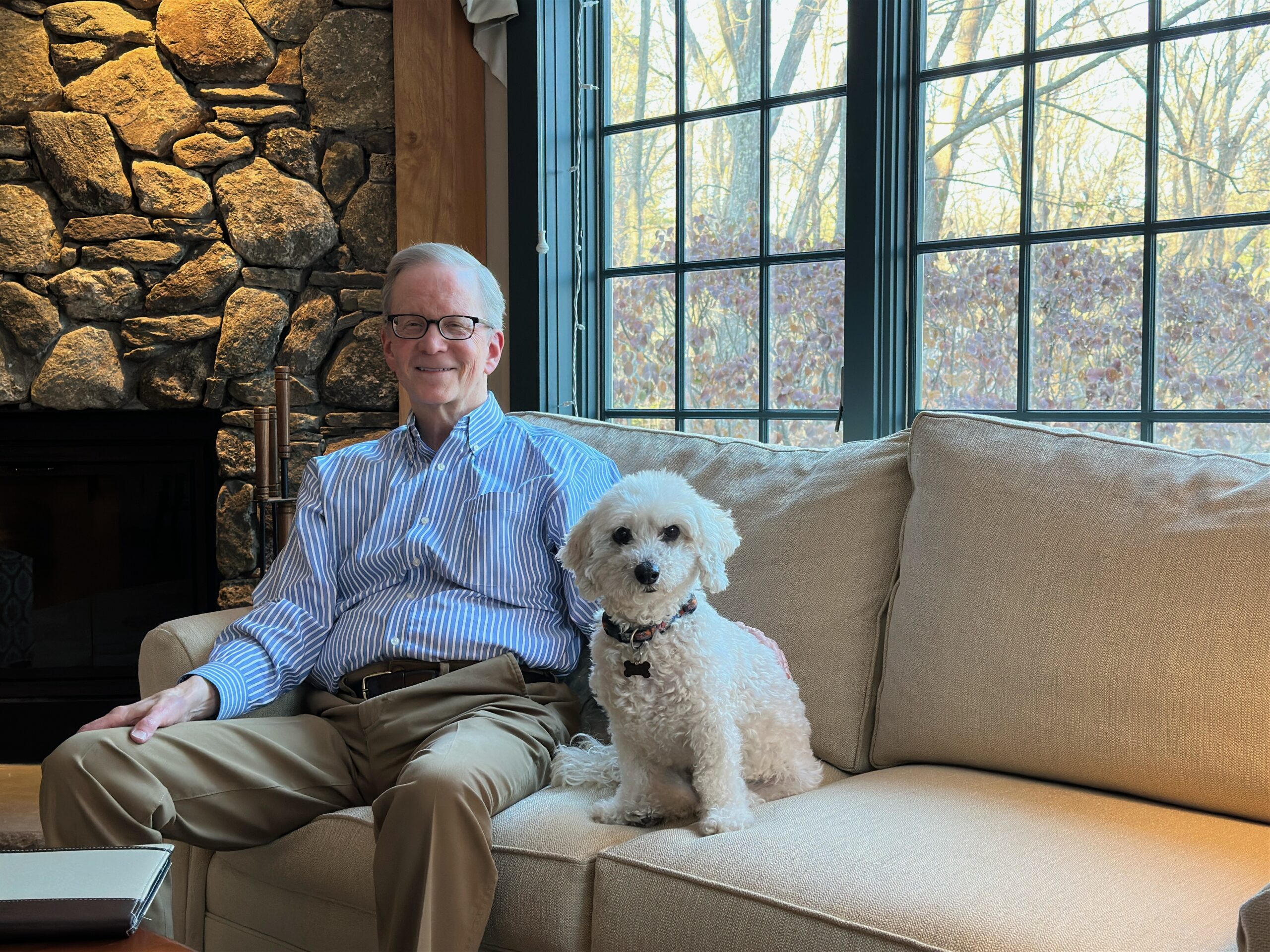
Jim McDaniel and Margaret Randle take an approach to philanthropy that is shaped by both the deep tragedy and profound kindness they have experienced over the course of their marriage. Their philanthropy goes far beyond just financial support — it is rooted in providing the means for life-changing programs to grow and expand over time, ensuring their longevity for generations to come.
When Jim and Margaret’s daughter, Susan, was 8 years old, she was diagnosed with a brain tumor that would eventually take her life. Throughout her treatment, “the staff at MGH were rock solid,” Jim reflects. To honor her memory, Jim and Margaret did something that would help change the future of care at MGH — they worked with the head of Hematology and Oncology to establish a research fund. “This fund has served as the springboard for a number of research studies and patient care initiatives,” says Jim.
But Jim’s involvement in philanthropy began even earlier. In the early 1980s, when he was an associate at Choate, Hall, & Stewart, a colleague asked him to take on pro bono work for an organization called DARE (which later became HopeWell).
At that time, he couldn’t have foreseen what DARE would become. “We were primarily state-funded, and there were enormous financial challenges,” Jim recalls. “The agency had lots of assets tied up in real estate for residential programs for teen boys. The state was moving away from supporting that model, so my job was to sell off some of their real estate. Although they had assets, there was a really unpredictable cash flow from the state. I remember ‘payless paydays,’ which were enormously stressful for the staff.”
Despite the challenges, the spirit of DARE made an indelible impression on Jim. “When DARE wasn’t getting paid by the state for the services provided, our fearless founder, Gerry Wright, chained himself to the State House gate in protest,” he recalls. Over time, Jim’s involvement went from professional to personal, and in 1986, he accepted a position on the Board.
By the early 2000s, DARE was in a much better place financially, but was still almost entirely state-funded, which limited the organization’s impact and exposure. “We were not out in the philanthropy world. No one knew about the great work we were doing unless they were involved in state agencies or local government,” Jim reflects. “Even though we had programs all over the state, I think we were Massachusetts’ best-kept secret.”
Then, in 2015, DARE’s long-time CEO announced his retirement. “It was evident that an executive transition would be needed,” remembers Jim, who at that point was Board Chair, but had been thinking about stepping down. “I felt I needed to see the organization through this important transition. We hired a search firm that told us our systems and procedures needed modernization and that DARE would really benefit from having someone come in who had a fresh eye.” A new era for DARE — which soon rebranded as HopeWell — began with our president & CEO, Shaheer Mustafa, at the helm.
“All foster care agencies focus on keeping kids physically safe — and DARE did a great job with that,” says Jim. But over the years, that wasn’t enough.
“There were issues around the periphery of foster care that were stubbornly problematic, leading to many disappointing long-term outcomes. Kids who were bounced around by the State to multiple placements in different towns and schools would fall horribly behind in their education. Then, when they reached a certain age, they would “age out” from the program with no support. Many would end up homeless, incarcerated, or pregnant. Although DARE had been concerned with these issues for a long time, Shaheer felt strongly that we should redouble our efforts and put together a brilliant team to take them on. We were launching all kinds of really innovative programs — I found myself thinking, ‘This is exciting!’“
"I want to support innovation for generations to come ... HopeWell is a serial entrepreneur in the foster care world. They come up with bold solutions and they help share what they've developed with as many other organizations as possible."
The innovation HopeWell was leading forced a change in revenue models, leaning into philanthropy as a critical source of funding for the first time. As HopeWell’s model evolved, Jim shared his passion with Margaret. “I started by going to the galas, heard people speak firsthand about what HopeWell is doing, and I saw the excitement building,” Margaret says. “It has become so much more tangible to me. Jim and I agree that this is an organization we want to provide ongoing support for. We can do more for them via our estate planning than we can do [directly] in the next few years.”
“I’m moving toward retirement and Margaret is working part-time,” Jim continues. “When I was still working, it was easier to commit to a large pledge. Now, there is more uncertainty around what we’ll need financially in the coming years. At the same time, we want to support an organization we’ve supported for 40 years with our contributions and efforts. Planned giving is a way to continue to do that without creating too much stress about whether we’re sacrificing the integrity of our retirement.”
For the first time, HopeWell was added to their estate plan. With this gift, Jim and Margaret aren’t only supporting specific programs — they’re helping ensure the future of care. “Our MGH fund provided seed money to get a grant, which funded a study that demonstrated the positive impact of a novel type of brain tumor therapy. We would hope that any gift we gave to HopeWell would provide a similar opportunity,” they say.
Jim knows that the need for the work will always be there. “20 years ago, if HopeWell had asked to consider planned giving, I wouldn’t have been so sure they would still be around when the time came,” Jim shared candidly. “But now, I think the work they’re doing is so innovative and so important to child welfare, they are going to be around for a long time.”
"We have no doubt that our contributions will be put to good use. Some organizations are so big that our contributions would be a drop in the bucket. Other organizations, you worry they won't be around. We both feel that HopeWell will be around and doing important, innovative work— and that our money will make a difference."
We are honored to name Jim as the inaugural Honorary Chair of our Dare to Hope Society.
6 Questions With Jim McDaniel
1. What do you wish more people understood about foster care?
Foster care is difficult and complicated. The execution part takes an enormous amount of skill and patience. And while keeping kids safe is the #1 priority, meeting their needs goes so far beyond that. If we keep them safe during their childhood and then set them adrift when they turn 18, we’ve failed them. Similarly, if they don’t learn how to read by 3rd grade and ultimately fall behind in school, we’ve failed them. Those issues have traditionally been seen as “outside” of foster care — someone else’s problem — but HopeWell refuses to see it that way.
2. What do you wish more people knew about HopeWell?
All of the children and families we’re serving have the potential to thrive. That’s the HopeWell mindset. It’s not just about taking care of them, although we’ll work tirelessly to make sure they’re well cared for. It’s ultimately about trying to unlock the potential in these lives. There is enormous potential in all of them — we see it all the time. You need look no further than our Board — there are multiple members of our Board who have lived experience in foster care. And they’ve been incredibly successful in life, despite going through some challenging times. They know firsthand both the challenges and the opportunities of the foster care system. They feel passionately that what we’re doing is not just taking care of people, it’s about giving them the supports to succeed.
3. What inspires you about HopeWell's Dare to Hope campaign?
Dare to Hope is HopeWell’s first capital campaign. For me, because of who HopeWell is and what HopeWell does as an innovator, having funding to launch new programs and expand promising ones without having to do so on a one-off basis all the time, would really help us do more. This includes both testing new programs and attracting the best staff — there are a lot of things we can do with a reliable pool of funding. Sometimes when there is a pressing need, we jump off the cliff and hope that someone will hand us a parachute. Having a reliable funding source to fuel innovation removes that risk.
4. Is there anything that worries you or keeps you up at night?
With the mission and staff we have at HopeWell, I don’t worry about the organization itself. I do worry about making sure we’re doing the best job every day for the children and families we’re caring for. It’s really hard work, and it’s easy to overlook the difficulties of the families who we’re trying to help. I also worry about the pressures on our staff due to the difficult nature of the work — and I worry about being able to attract and retain the best possible personnel. The pandemic was hard on us. If we don’t have really good people doing the work, it’s impossible to fulfill our mission.
5. If you could wave a magic wand and fix one thing about the foster care system right now, what would it be?
I would start with the most urgent issue — getting more foster parents. That’s a real problem right now. It’s always been tough, but there’s also a generational thing now — younger generations aren’t doing it as much. We have the systems in place to support them, but we can’t manufacture people to foster. We could place many more children if we had more foster parents. We are trying innovative approaches to reach out to potential foster parents and are making some headway.
6. What would your ideal long-term vision for the foster care system be?
I would like to see more emphasis on family support and stabilization before children end up getting removed from their homes. This is where our business model is leading us. Unfortunately, it’s often not possible. There are just too many untenable situations out there. Poverty drives much of the problem and is the #1 issue that leads to neglect. Without solving poverty, we may never be able to solve the problems in child welfare. There will always be a need for good foster care because even if a family is able to provide adequate support for their children, there will be periods when they can’t, and foster care is a temporary solution. Then, helping to reunite them with their families — along with meaningful, ongoing support — becomes our goal.
The challenge is that there are systemic issues that will continue to create roadblocks — poverty, racial disparities and discrimination, racism — that cause a disproportionate number of children of color to end up in the child welfare system.
While HopeWell can’t solve all of these societal problems, I really believe our work — including our excellent advocacy work — contributes to a long-term solution and, in the meantime, changes the course of hundreds of lives for the better.